Last Updated: January 4, 2026. Please report broken links here.
The following timeline is in no way comprehensive. It does, however, highlight the complex interplay between the:
- Venezuela/Guyana border dispute;
- Rise of socialism;
- Destruction of Venezuela’s economy;
- Drug trafficking; and
- Venezuela’s relationships with China, Russia, and Iran.
If you find this article useful, you might enjoy my newsletter – I email notes on everything I research. Feel free to subscribe here.
Venezuela Background: 1814 – 2026
1814: Great Britain acquires British Guiana (now Guyana) by treaty with the Netherlands.
1835: Great Britain commissions a surveyor, Robert Schomburgk, to draw the Venezuela/British Guiana boundary (called the Schomburgk Line).
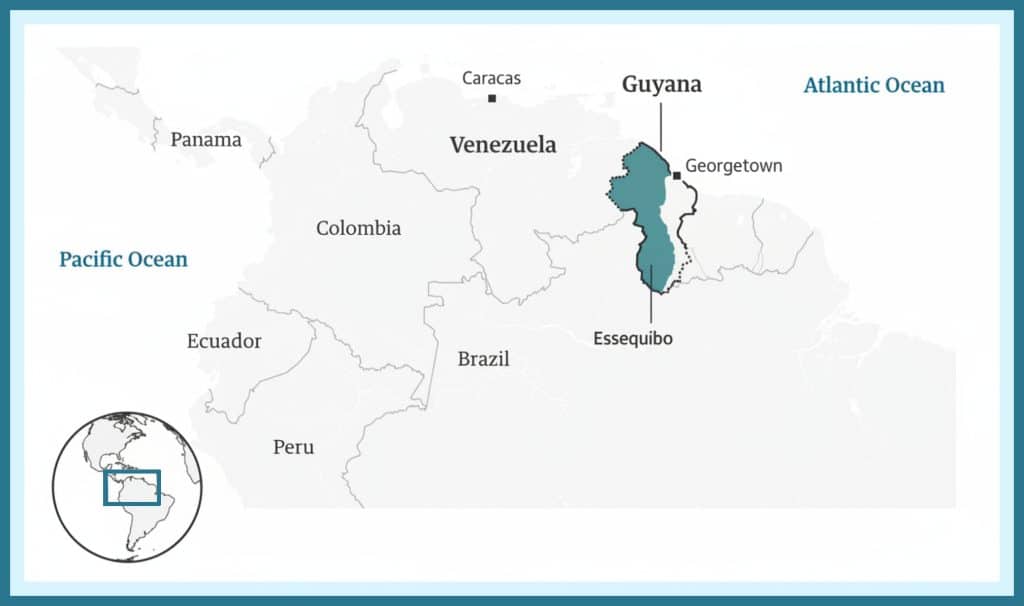
1841: Venezuela disputes the British Guiana boundary, claiming their border extends as far east as the Essequibo River (representing two-thirds of British Guiana). The area is collectively called “Essequibo”.
1876-1895: Venezuela repeatedly asks the United States to weigh in on the British Guiana issue.
1895: U.S. President Grover Cleveland creates a boundary commission to assess the Venezuela-British Guiana border.
October 3, 1899: Venezuela and the United Kingdom set up an international tribunal to resolve the British Guiana dispute. Venezuela is represented by the U.S.; British Guiana by the U.K. A Russian judge serves as a neutral third-party. The ruling (known as the “1899 Award”) goes in favor of British Guiana, confirming the Schomburgk Line was correct. However, Venezuela will later reject the decision, claiming Russia and the U.K. made a back-room deal.
1922: Geologists strike oil in Venezuela.
1958: Venezuela elects its first stable democratic government.
1960: Venezuela becomes a founding member of the Organization of the Petroleum Exporting Countries (OPEC).
1962: Venezuela formally contests the 1899 Award, filing a complaint with the United Nations regarding the British Guiana ruling.
February 17, 1966: Venezuela and the U.K. adopt the Geneva Agreement, agreeing that Venezuela and British Guiana will work out their border dispute; if not, the United Nations will intervene.
May 26, 1966: British Guiana gains independence under its new name, Guyana.
1970s: Thanks to oil profits, Venezuela’s per capita income becomes the highest of any country in Latin America.
1976: Venezuelan President Carlos Andrés Pérez creates a state-run oil company, Petroleos de Venezuela, S.A. (PDVSA), to supervise the oil industry.
1980s: Oil prices plummet, Venezuela’s economy declines and inflation soars.
1992: Military officer Hugo Chávez launches a failed coup against President Perez and rises to national fame.
1999: Hugo Chávez is elected President of Venezuela and immediately begins his socialist “Bolivarian Revolution” – ushering in a new era of authoritarian rule.
1999: With large ports, access to the mountainous regions of Colombia, and an increasingly corrupt government, Venezuela becomes a safe haven for drug traffickers.
1999: The 76th Group Army of the Chinese People’s Liberation Army (PLA) begins training jointly with Venezuelan Special Forces on language, diving, sniping, and helicopter landing operations. Reporting from 2020 confirms training is still ongoing.
1999-2013: Chávez visits Russia nine times and China six.
2000: Future President Nicolás Maduro joins Venezuela’s National Assembly.
2004: Maduro begins trafficking cocaine (often selling product seized by Venezuelan law enforcement) with the assistance of armed military escorts; he’ll later order the kidnapping and murder of those who owe money.
2005: Chávez awards Iran President Mohammad Khatami the Order of the Liberator.
2005: U.S. President George Bush reports to Congress that Venezuela “failed demonstrably” during the previous 12 months to adhere to their obligations under international counternarcotics agreements.
2006: Maduro is named Venezuelan Minister of Foreign Affairs.
2006: Iran President Mahmoud Ahmadinejad awards Chávez the Higher Medal of the Islamic Republic of Iran.
2006: Venezuelan officials dispatch more than 5.5 tons of cocaine from Venezuela to Mexico on a DC-9 jet, which is later seized by Mexican authorities.
July 2006: Defying the United States, Russia agrees to sell $1 billion in combat aircraft to Venezuela. Between 2002-2022, Russia will sell Venezuela $11.4 billion in military equipment.
2006-2008: While Minister of Foreign Affairs, Maduro sells diplomatic passports to drug traffickers moving proceeds from Mexico to Venezuela; he also supplies private planes.
2007-2016: Venezuela becomes the single largest recipient of Chinese finance in the world.
January 10, 2007: Chávez announces that Venezuela will nationalize its private sectors, including oil projects owned by foreign companies, such as ExxonMobil, Chevron, and ConocoPhillips. Chevron reaches an agreement allowing limited operation, but ExxonMobil and ConocoPhillips exit and pursue international arbitration. Tribunals will eventually rule that Venezuela’s expropriation was illegal under international law and award both companies billions (although Venezuela will fail to pay). Claims by the Trump administration in 2025-26 that Venezuela “stole” oil profits are rooted in this dispute.
2007: A Venezuelan General delivers four crates of weapons from the government to narco-terrorist group, FARC (including 20 grenades and two grenade launchers).
2008: The U.S. labels two Venezuelan State Governors as “Specially Designated Nationals and Blocked Persons” under the Foreign Narcotics Kingpin Designation Act for assisting FARC in drug trafficking.
March 2009: The U.S. Department of State reports that Venezuela has become a major route for trafficking cocaine out of Colombia, with more than a four-fold increase in cocaine flow between 2004 and 2007.
July 2009: The U.S. Government Accountability Office notes that Venezuela’s non-compliance is hindering the prevention of narcotics flowing from Colombia to Venezuela.
2010: China and Venezuela reaffirm mutual commitments and expand their Sino-Venezuelan joint fund by $20 billion.
2011: U.S. designates four additional Venezuelan government officials under the Foreign Narcotics Kingpin Act.
2012-2022: China sells upward of $615 million in weapons to Venezuela.
2013: The U.S. designates a former captain in the Venezuelan National Guard under the Foreign Narcotics Kingpin Designation Act.
2013: Maduro becomes Vice President of Venezuela.
March 5, 2013: Chávez dies.
April 19, 2013: Maduro becomes President of Venezuela.
2013-2017: Iran President Hassan Rouhani meets 13 times with Maduro and other high-level Venezuelan officials.
September 2013: Venezuelan officials dispatch approximately 1.3 tons of cocaine on a commercial flight to Paris. French authorities seize the drugs.
2013-2023: Living standards in Venezuela plummet by 74 percent, marking the fifth largest fall in modern economic history. According to the Economics Observatory: “In most countries, the judiciary or legislature would have contained the damage long before by stopping policies like uncompensated expropriations, price controls, profit controls, central bank money printing and extra-budgetary spending – but Venezuela did not have such checks and balances. Presidents Chávez and Maduro had captured and hollowed out the country’s democratic institutions”.
2013-2025: Russian President Vladimir Putin and Maduro meet over ten times.
October 9, 2014: An International Centre for Settlement of Investment Disputes tribunal rules Venezuela must pay ExxonMobil $1.6 billion for nationalizing its projects (ExxonMobil originally claimed $14.5 billion, while Venezuela offered $353 million). As of publication, the debt is still unpaid (minus small partial payments).
2015: The U.S. Department of the Treasury’s Financial Crimes Enforcement Network issues a finding under that Maduro was involved in embezzling from Venezuela’s state-owned oil company, PdVSA.
March 8, 2015: Citing “erosion of human rights guarantees, persecution of political opponents, curtailment of press freedoms, use of violence”, U.S. President Barack Obama signs Executive Order 13692 “Blocking Property and Suspending Entry of Certain Persons Contributing to the Situation in Venezuela”.
May 20, 2015: ExxonMobil announces a significant oil discovery offshore Guyana. Future exploration will reveal they’d discovered a resource base equivalent to roughly 11 billion barrels of oil.
October-November 2015: During recorded meetings with U.S. Drug Enforcement Agency confidential sources, two Maduro family members agree to dispatch multi-hundred-kilogram cocaine shipments from Maduro’s “presidential hangar” at the Maiquetia Airport. The Maduro family members explain that they are at “war” with the United States.
2017: In its first year ranking political rights and civil liberties in Venezuela, Freedom House scores Venezuela 30/100 (“not free’”).
August 24, 2017: U.S. President Donald Trump imposes additional sanctions on Venezuela (see: E.O. 13808).
November 21, 2017: Six American oil executives, known as the CITGO-6, are lured to Venezuela for business meetings and thrown into prison.
2018: Russian military aircraft begin routinely arriving in Venezuela; Russian military advisors regularly appear at military installations, carry out training exercises, and provide logistical support to Maduro’s military.
January 30, 2018: The United Nations Secretary-General finally selects a means for settling Venezuela’s Guyana dispute: International Court of Justice proceedings. Venezuela refuses to participate based on jurisdiction objections.
March 19, 2018: Trump adds more sanctions to Venezuela via Executive Order 13827.
May 20, 2018: Madura declares himself President again, despite a contested election.
May 21, 2018: Trump adds more sanctions to Venezuela via Executive Order 13835.
June-December 2018: Maduro increasingly relies on his self-created Special Action Force of the National Police (FAES) to conduct illegal raids and extrajudicial killings. The FAES, comprised of 1,300 officers, is accused of killing more than 100 people.
October 2018: Venezuelan Councilman Fernando Alban travels to the United Nations General Assembly to denounce Maduro’s brutality. When he returns to Venezuela on October 5, Maduro’s secret police arrest him at the airport. He dies in custody a few days later after mysteriously falling from a 10th floor window of a maximum-security prison.
November 1, 2018: Trump adds more sanctions to Venezuela via Executive Order 13850.
2019: The National Assembly of Venezuela declares Maduro usurped power in the 2018 election and is not the president of Venezuela. America and 50+ nations refuse to recognize Maduro as President.
January 21-April 19, 2019: The Maduro regime detains 1,255 people. There are also at least 40 protest-related deaths.
January 25, 2019: Trump broadens the definition of “Government of Venezuela” via Executive Order 13857.
March 8, 2019: An International Tribunal orders Venezuela to pay ConocoPhillips $8.7 billion for “unlawful expropriation” during its 2007 nationalization. To date, Venezuela hasn’t paid ConocoPhillips (Venezuela tried, and failed, to have the judgement annulled in January 2025).
March 20, 2019: The U.N. High Commissioner for Human Rights goes on record claiming Madura’s police force (FAES) executed 37 people in connection with illegal home invasion raids in January.
March 21, 2019: Maduro’s police (FAES) raid the home of his Presidential opponent Juan Guaidó’s chief of staff, Roberto Marrero, and arrest him.
December 20, 2019: Exxon begins oil production in Guyana.
2020: The U.S. State Department estimates that between 200 and 250 tons of cocaine is trafficked through Venezuela annually.
2020: Maduro wrongfully imprisons two Americans.
2020: Maduro’s son attends a meeting in Columbia with two FARC representatives, discussing arrangements to move large quantities of cocaine and weapons through Colombia and into the United States over the course of the next six years.
2020: The U.S. offers up to $15 million for information leading to the arrest and/or conviction of Maduro.
May 2020: Iran defies U.S. sanctions and sends multiple oil tankers to Venezuela.
December 18, 2020: The International Court of Justice confirms it does have jurisdiction in the Venezuela/Guyana case and begins proceedings. The final ruling hasn’t been issued as of publication.
March 26, 2020: The United States names Maduro in a criminal indictment, accusing Maduro of leading a narcotics trafficking ring with connections to Colombia’s FARC guerrillas. According to U.S. Attorney Geoffrey S. Berman: “As alleged, Maduro and the other defendants expressly intended to flood the United States with cocaine in order to undermine the health and wellbeing of our nation. Maduro very deliberately deployed cocaine as a weapon.”
May 2021: Direct flights between Caracas, Venezuela and Moscow, Russia begin operating via Venezuela’s state airline.
October 2021: Iran President Ebrahim Raisi says, “Latin American countries, especially Venezuela, are amongst the economic diplomacy priorities of the Islamic Republic of Iran and we are determined to develop our relations with these countries”.
November 30, 2021: U.S. President Joe Biden revokes FARC’s terrorist designation.
2022: Maduro wrongfully imprisons three Americans.
2022: Thanks to its new oil production, Guyana has the fastest GDP growth in the world.
March 8, 2022: As part of a prisoner swap, Venezuela releases two wrongfully detained Americans (including one of the CITGO-6).
June 11, 2022: Iran and Venezuela sign a 20-year bilateral cooperation road map.
October 1, 2022: As part of a prisoner swap, Venezuela releases 7 wrongfully detained Americans (including the 5 remaining CITGO-6). In exchange, Biden grants clemency to two of Maduro’s wife’s nephews, who were convicted in 2016 of transporting hundreds of kilograms of cocaine destined for the United States.
December 2022: Russia and Venezuela collaborate on the Russian-Venezuelan Centre for Infectious Disease Research and Prevention.
September 13, 2023: Chinese President Xi Jinping and Maduro announce the elevation of the China-Venezuela relationship to an “all-weather strategic partnership”.
October 18, 2023: Biden lifts several Venezuela sanctions.
2023: Maduro wrongfully imprisons another American.
December 5, 2023: After holding a referendum, Maduro defies the International Court of Justice and orders the creation of a new state called “Guayana-Esequiba”.
December 6, 2023: Maduro orders the arrest of a dozen opposition members.
December 14, 2023: Maduro meets with Guyana’s President and agrees they “will refrain, whether by words or deeds, from escalating any conflict or disagreement arising from any controversy between them”.
December 20, 2023: Biden frees an ally of Maduro for the release of 10 imprisoned Americans.
2024: Venezuela wrongfully imprisons 3 Americans.
2024: Venezuela begins accepting Russia’s Mir payment system cards via partner bank terminals.
January 2024: Maduro begins moving substantial military personnel and equipment to sites near the disputed Guyana border. According to figures published by Brazilian sources, the Venezuelan military has 123,000 active personnel while Guyana has 3,400. Guyana is also outpaced in terms of weaponry, including armored vehicles (514 versus 6).
February 9, 2024: Human rights activist Rocío San Miguel and five family members are accused of conspiring against Maduro and arrested by the Venezuelan police.
March 14, 2024: The European Parliament claims there are over 300 political prisoners in Venezuela.
March 2024: The Venezuelan Parliament defies the International Court of Justice and approves the creation of a state in the Guyana Essequibo region.
April 20, 2024: The Venezuelan military launches a field exercise (far from Guyana), involving as many as 4,000 cadets, under the operational name “The Essequibo is Ours”.
July 2024: Maduro declares himself the Presidential winner in another disputed election.
August 1, 2024: The United States recognizes Maduro’s Presidential opponent as the winner. U.S. Secretary of State Antony Blinken says Maduro’s presidential win “came with no supporting evidence” and that “it is clear to the United States and, most importantly, to the Venezuelan people that Edmundo González Urrutia won the most votes in Venezuela’s July 28 presidential election.”
2025: Ranking political rights and civil liberties in Venezuela, Freedom House scores Venezuela 13/100 (“not free”) – a 17 point decrease from eight years prior, due partially to a 0/40 score on political rights.
2025: Venezuela wrongfully imprisons another American.
January 10, 2025: Biden increases the reward for capturing Maduro from $15 million to $25 million.
March 14, 2025: Russia and Venezuela celebrate 80 years of diplomatic relations, which Russia says “moved to a new level during the rule of President Hugo Chávez” (who the Russia Foreign Minister calls a “true patriot and a loyal son of his country”).
March 15, 2025: Trump invokes the Alien Enemies Act regarding the Tren de Aragua (TdA) cartel, which operates in conjunction with Maduro’s Cártel de los Soles, claiming it is “perpetrating, attempting, and threatening an invasion or predatory incursion against the territory of the United States” at the direction of the Maduro regime.
May 2, 2025: The International Court of Justice says Venezuela must “refrain from conducting elections, or preparing to conduct elections, in [Essequibo/Guyana].”
May 7, 2025: Guyana recognized for having an oil GDP increase of 58% since 2024.
May 9, 2025: Chinese President Xi Jinping meets with Maduro in Moscow. China’s Office of Foreign Affairs said “the two sides have forged an ironclad friendship”.
May 25, 2025: Maduro defies the International Court of Justice and holds elections for a governor and other lawmakers for Essequibo.
May 27, 2025: The Trump White House notes “more U.S. nationals are currently wrongfully detained in Venezuela than in any other country” and issues an alert warning U.S. citizens against travel to Venezuela. The Department of State assigns Venezuela its highest Travel Advisory level due to severe risks including wrongful detention, torture in detention, terrorism, kidnapping, unfair law enforcement practices, violent crime, civil unrest, and inadequate healthcare.
July 21, 2025: Venezuela releases 10 wrongfully imprisoned Americans.
August 7, 2025: Trump increases the reward for information leading to the arrest and/or conviction of Maduro to $50 million.
September 2-December 2, 2025: The U.S. military’s counter-narco-terrorism campaign, Operation Southern Spear, conducts 21 kinetic strikes on what U.S. officials say are drug boats operating in the Caribbean and eastern Pacific. (The reported total as of December 31, 2025 is 32).
November 24, 2025: The U.S. Department of State designates Cartel de los Soles, led by Maduro, as a Foreign Terrorist Organization and says Maduro does not represent “Venezuela’s legitimate government”.
December 10, 2025: The United States seizes an oil tanker off the coast of Venezuela which the U.S. claims is tied to a sanctions-evading smuggling network that moved Iranian oil to fund Hezbollah and Iran’s Islamic Revolutionary Guard.
December 11, 2025: White House Press Secretary Karoline Leavitt tells reporters the United States was “not going to stand by and watch sanctioned vessels sail the seas with black market oil, the proceeds of which will fuel narcoterrorism of rogue and illegitimate regimes around the world.”
December 16, 2025: Trump orders a “complete blockade of all sanctioned oil tankers going into, and out of, Venezuela”.
December 20, 2025: The U.S. seizes a second Venezuelan oil tanker.
December 22, 2025: China and Russia reiterate support for Venezuela.
December 26, 2025: The U.S. executes land strikes (first of strikes to aim for land) on a loading facility linked to Venezuelan drug boats.
December 31, 2025: The U.S. Department of the Treasury’s Office of Foreign Assets Control sanctions four companies for operating in Venezuela’s oil sector, saying the vessels “some of which are part of the shadow fleet serving Venezuela, continue to provide financial resources that fuel Maduro’s illegitimate narco-terrorist regime”.
January 3, 2026: Trump announces: “The United States of America has successfully carried out a large-scale strike against Venezuela and its leader, President Nicolas Maduro, who has been, along with his wife, captured and flown out of the Country [to the United States]”. Vice President Vance says Trump offered Maduro “multiple off ramps” before the attack. The Department of Justice releases official indictments against Nicolas Maduro, his wife Cilia Flores, and other Venezuelan officials. Maduro’s charges include: narco-terrorism conspiracy, cocaine importation conspiracy, possession of machine guns and destructive devices, and conspiracy to possess machine guns and destructive devices against the United States. Trump leads a press conference where the U.S. President says the United States will govern Venezuela until there’s a “proper transition.”
January 4, 2026: U.S. Secretary of State Marco Rubio confirms: “There’s not a war. We are at war against drug trafficking organizations — not a war against Venezuela.” Rubio adds: “In the Biden Administration, they had a $25 million reward for [Maduro’s] capture — so we have a reward for his capture but we’re not going to enforce it? That’s the difference between President Trump and everybody else… President Trump did something about it.”
Subscribe to my newsletter for more posts like this!
References
Abrams, E. (18 September 2024). More Hostages But No More Sanctions: The Failure of Biden Administration Venezuela Policy. Council on Foreign Relations.
Argus. (23 January 2025). Venezuela loses appeal of $8.5bn ConocoPhillips award.
Arocha, J.G. (21 January 2022). Examining Russian and Chinese Military Operations in Venezuela. Dialogo Americas.
Associated Press. (11 December 2025). WATCH: White House says Trump administration plans to ‘seize’ oil from tanker taken off Venezuela coast. PBS News.
Associated Press. (20 May 2018). Maduro declared winner of second term in Venezuela amid severe crisis. NBC News.
Biden, J. (8 March 2022). Statement of President Joe Biden on the Return of American Detainees from Venezuela. The White House.
Birchall, G. & Kord, J. (29 December 2025). US Forces Took Out Drug Boat Facility as Part of Anti-Drug Campaign: Trump. The Epoch Times.
Blinken, A. (1 August 2024). Assessing the Results of Venezuela’s Presidential Election. U.S. Department of State.
Blinken, A. (30 November 2021). Revocation of the Terrorist Designations of the Revolutionary Armed Forces of Colombia (FARC) and Additional Terrorist Designations. U.S. Department of State.
Cano, R.G. (6 December 2023). Venezuela’s AG orders arrest of opposition members, accuses them of plotting against referendum. Associated Press.
ConocoPhillips Petrozuata B.V. et al. v. Bolivarian Republic of Venezuela. (22 January 2025). ICSID Case No. ARB/07/30, Annulment Proceeding.
ConocoPhillips. (8 March 2019). International Arbitration Tribunal Orders Venezuela to Pay ConocoPhillips $8.7 Billion for Unlawful Expropriation of Company’s Oil Investments.
Creutzfeldt, B. & D’Sola Alvarado, P. (16 February 2024). Venezuela, the State That Refuses to Collapse. What is China’s Role?. Stimson.
Da, W. & Yukai, W. (7 May 2020). Chinese special operations cadets trained in Venezuela. China Military.
Department of Public Information, Guyana. (15 December 2023). The joint declaration of Argyle for dialogue and peace between Guyana and Venezuela.
Embassy of the Cooperative Republic of Guyana. (4 October 2024). Ministry of Foreign Affairs and International Cooperation in commemoration of the 125th Anniversary of the Arbitral Award which settled the land Boundary between British Guiana and Venezuela.
European Parliament. (14 March 2024). The case of Rocío San Miguel and General Hernández Da Costa, among other political prisoners in Venezuela.
Executive Order 13857. (25 January 2019). Taking Additional Steps To Address the National Emergency With Respect to Venezuela.
Executive Order 13850. (1 November 2018). Blocking Property of Additional Persons Contributing to the Situation in Venezuela.
Executive Order 13835. (21 May 2018). Prohibiting Certain Additional Transactions With Respect to Venezuela.
Executive Order 13827. (19 March 2018). Taking Additional Steps to Address the Situation in Venezuela.
Executive Order 13808. (24 August 2017). Imposing Additional Sanctions With Respect to the Situation in Venezuela.
Executive Order 13692. (8 March 2015). Blocking Property and Suspending Entry of Certain Persons Contributing to the Situation in Venezuela.
ExxonMobile. (16 May 2025). High-speed Guyana: An energy superpower practically overnight.
ExxonMobil. (20 May 2015). ExxonMobil announces significant oil discovery offshore Guyana.
Freedom House. (2025). Venezuela. Freedom in the World.
Freedom House. (2017). Venezuela. Freedom in the World.
Foley Foundation. (20 December 2023). Foley Foundation Celebrates Detainee Releases in Venezuela.
Geneva Agreement. (17 February 1966).
Gillmore, T. (11 December 2025). US Sanctions Maduro Family Members, 6 Ships Transporting Venezuelan Oil. The Epoch Times.
Global Public Affairs. (21 November 2020). Anniversary of the Wrongful Detention of the CITGO-6 in Venezuela. U.S. Department of State.
Guardian Staff. (22 December 2025). Russia and China pledge support for Venezuela as Trump ratchets up pressure on Maduro. The Guardian.
Gunson, P. (8 April 2025). Venezuela Presses Territorial Claims as Dispute with Guyana Heats Up. International Crisis Watch.
Hernandez-Roy, C. et al. (9 February 2024). Miscalculation and Escalation over the Essequibo: New Insights into the Risks of Venezuela’s Compellence Strategy. Center for Strategic & International Studies.
International Court of Justice. (2 May 2025). Arbitral Award of 3 October 1899 (Guyana v. Venezuela).
International Court of Justice. (18 December 2020). Case: 171 – Arbitral Award of 3 October 1899 (Guyana v. Venezuela).
International Monetary Fund. (7 May 2025). IMF Executive Board Concludes 2025 Article IV Consultation with Guyana.
International Monetary Fund. (11 September 2023). Guyana Staff Concluding Statement of the 2023 Article IV Mission.
International Centre for Settlement of Investment Disputes. (9 October 2014). Venezuela Holdings B.V. et al. v. The Bolivarian Republic of Venezuela.
International Poverty Reduction Center in China. (15 September 2023). Xi, Maduro announce elevation of China-Venezuela ties.
Islamic Republic of Iran. (18 October 2021). Iran’s policy to deepen ties with LatAm states, esp. Venezuela/ Despite sanctions, issues caused by enemies, we’ll continue development path powerfully. Official Website of the President of the Islamic Republic of Iran.
Keenan, C. (4 January 2026). ‘Deeply shocked’: World leaders react to US attack on Venezuela. BBC.
Kube, C. & Tsirkin. (20 December 2025). U.S. Coast Guard intercepts a second oil tanker off the Venezuelan coast. NBC News.
Lob, E. (22 August 2022). Iran-Venezuela relations: Presidents, postures, and pressures. Middle East Institute.
Menke, J.K. (12 December 2025). Independence of Guyana. Britannica.
Ministry of Foreign Affairs People’s Republic of China. (10 May 2025). Xi Jinping Meets with Venezuelan President Nicolás Maduro Moros.
Morgan, R. (31 December 2025). US Sanctions 4 More Companies, 4 More Oil Tankers Accused of Serving Venezuela. The Epoch Times.
Muci, F. (23 September 2024). Why did Venezuela’s economy collapse?. Economics Observatory.
Nagle, M. & Hutzler, A. (1 October 2022). 7 Americans released from detention in Venezuela, Biden says. ABC News.
Noem, K. (20 December 2025). Second Seized Tanker. X: @Sec_Noem.
Office of Foreign Assets Control. (n.d.). Venezuela Sanctions.
Office of Foreign Assets Control. (18 October 2023). Frequently Asked Questions Related to the Suspension of Certain U.S. Sanctions with Respect to Venezuela on October 18, 2023.
Office of the Press Secretary. (15 September 2005). Statement on President Authorizing Secretary of State to Transmit to Congress Annual Report Listing Major Illicit Drug-Producing and Drug-Transit Countries.
Olay, M. (2 December 2025). Pentagon Provides Update on Operation Southern Spear, Reaffirms Socom Called for Second Strike on Drug Boat. U.S. Department of War.
Ozimek, T. (18 December 2025). Trump Demands Venezuela Return Seized US Oil Assets After Ordering Tanker Blockade. The Epoch Times.
Pomson, O. (April 2025). Arbitral Award of 3 October 1899 (Guyana v. Venezuela). American Journal of International Law, 119(2): 306-12.
Raisbeck, D. (5 December 2023). Will Nicolás Maduro Invade Guyana?. CATO Institute.
Rendon, M., De La Cruz, A. & Fernandez, C. (4 June 2020). Understanding the Iran-Venezuela Relationship. Center for Strategic & International Studies.
Rios, M. (25 May 2025). Venezuela held an election for an oil-rich region. The main problem is it belongs to another country. CNN.
Roy, D. & Cheatham, A. (31 July 2024). Venezuela: The Rise and Fall of a Petrostate. Council on Foreign Relations.
Rubio, M. (16 November, 2025). Terrorist Designations of Cartel de los Soles. U.S. Department of State.
Shaw, R. (2024). Crisis on the Essequibo: The Implications of Venezuelan Aggression Towards Guyana as Non-Compliance with ICJ Provisional Measures. Michigan Journal of International Law.
U.S. Department of State. (n.d.). 2016 International Narcotics Control Strategy Report (INCSR).
United States Drug Enforcement Administration. (26 March 2020). Nicolás Maduro Moros and 14 current and former Venezuelan officials charged with narco-terrorism, corruption, drug trafficking and other criminal charges.
United States Government Accountability Office. (20 July 2009). Drug Control: U.S. Counternarcotics Cooperation with Venezuela Has Declined.
U.S. Office of the Spokesperson. (27 May 2025). U.S. Citizens Face Significant Risk of Wrongful Detention in Venezuela. The White House.
United Nations. (30 January 2018). Secretary-General Chooses International Court of Justice as Means for Peacefully Settling Long-Standing Guyana-Venezuela Border Controversy.
United States v. Nicolas Maduro Moros, Diosdado Cabello Rondon, Ramon Rodriguez Chacin, Cilia Adela Flores de Maduro, Nicolas, Ernesto Maduro Guerra, and Hector Rusthenford Guerrero Flores. Sealed Superseding Indictment. S4 11 Cr. 205 (AKH).
U.S. Department of Justice. (26 March 2020). Nicolás Maduro Moros and 14 Current and Former Venezuelan Officials Charged with Narco-Terrorism, Corruption, Drug Trafficking and Other Criminal Charges.
U.S. Department of State. (7 August 2025). Nicolás Maduro Moros. Bureau of International Narcotics and Law Enforcement Affairs.
U.S. Department of State. (15 April 2019). Nicolás Maduro: Corruption and Chaos in Venezuela.
U.S. Department of State. (n.d.). Venezuela.
U.S. Department of Treasury. (31 December 2025). Treasury Targets Oil Traders Engaged in Sanctions Evasion for Maduro Regime.
U.S. Office of the Historian. (n.d.). Venezuela Boundary Dispute, 1895–1899. Department of State.
Taylor, L. (6 December 2023). Guyana appeals to US and UN as Maduro advances annexation of territory. The Guardian.
The Epoch Times Staff. (3 January 2026). US Captures Venezuela’s Maduro, Trump Says. The Epoch Times.
The Ministry of Foreign Affairs of the Russian Federation. (14 March 2025). Article by Foreign Minister Sergey Lavrov, Russia and Venezuela: Friendship and Partnership Spanning Years and Kilometres, dedicated to the 80th anniversary of diplomatic relations between Russia and Venezuela, for Cancilleria, a Venezuelan Foreign Ministry publication, March 14, 2025.
The White House. (4 January 2026). RUBIO: This Is Our Hemisphere — and President Trump Will Not Allow Our Security to be Threatened.
Trump, D. (3 January 2026). President Trump Holds a Press Conference, Jan. 3, 2026. The White House.
Trump, D. (3 January 2026). Venezuela Strike Announcement. Truth Social: @realDonaldTrump.
Trump, D. (16 December 2025). Trump Orders Oil Blockade. Truth Social: @realDonaldTrump.
Trump, D. (10 December 2025). President Trump Hosts a Roundtable Discussion with Business Leaders. C-SPAN.
Trump, D. (15 March 2025). Invocation of the Alien Enemies Act Regarding the Invasion of The United States by Tren De Aragua. The White House.
Vance, J.D. (3 January 2026). Maduro Off Ramps. X: @JDVance.
WOLA. (31 December 2025). Facts to Inform the Debate about the U.S. Government’s Anti-Drug Offensive in the Americas. The Washington Office on Latin America (WOLA).
Wolland, J. (July 2009). Venezuela, Russia Sign Weapons Deal. Arms Control Association.
LIKE THIS ARTICLE? SHARE WITH YOUR FRIENDS: